When political science research informs public debate: French politics is speaking out… because it is searching for its path
Research in the humanities and social sciences does not merely observe the political world from a distance. It also makes it possible to unravel its mechanisms, look beyond immediate impressions, and make sense of what, at first glance, seems incomprehensible. The recent work of Florent Gougou, an associate professor of political science at Sciences Po Grenoble – UGA, offers an exemplary illustration of this. Published in the Revue française de science politique, his work was recently featured and discussed in Le Monde, a sign of its significance beyond the academic sphere alone.
Since the 2022 elections and, even more so, the 2024 election cycle, the prevailing view has been one of political “chaos”: a fragmented National Assembly, the absence of a majority, fragile governments, and institutional deadlocks. For many, this situation is seen as proof that the system is on its last legs. Florent Gougou ’s research invites a completely different perspective. No, France is not plunged into unprecedented and unpredictable disorder. Rather, it is engaged in the consolidation of a new electoral order, whose rules are no longer those of the past.
To understand this argument, we must return to a central idea in political science theory—the theory of realignments: political life in democratic systems can be described as a succession of relatively stable periods, separated by moments of upheaval known as “realignments.” In France, an electoral order structured around the alternation between left- and right-wing governments was in place between 1984 and 2007. However, it collapsed in 2007, ushering in a phase of broad and lasting changes, until the 2017 and 2019 elections marked the entry into a new world. A new world centered on three unprecedented poles: a reconstituted left dominated by its radical fringe, a liberal center, and a radical right that has become unavoidable.
Far from being an anomaly, the 2024 elections confirm this new political landscape. The election results show remarkable stability in the balance of power among these three blocs, despite the intensity of the political crisis. In other words, what appears to be governmental instability does not reflect electoral disorder, but rather a disconnect between political practices inherited from the old world and a profoundly transformed electoral landscape.
This is where research sheds light on the public debate. The current “deadlock” stems not so much from the institutions themselves as from the difficulty political actors have in adapting to a system where negotiation, compromise, and coalitions are becoming the norm. While other European democracies have long embraced these principles, French political culture remains largely shaped by the idea of an absolute majority and a top-down structure of power.
By shedding light on these long-term dynamics, Florent Gougou’s work demonstrates in concrete terms the purpose of political science: not to predict the future or settle partisan debates, but to provide tools for understanding the profound transformations of democratic life. Far from the sometimes caricatured notion of “theoretical tinkering,” research in the humanities produces robust, data-driven analyses capable of enlightening both citizens and policymakers.
The fact that this research has been featured in *Le Monde* is no small matter. It demonstrates that rigorous research conducted at Sciences Po Grenoble – UGA can fuel public debate and contribute to a clearer understanding of our democracy.
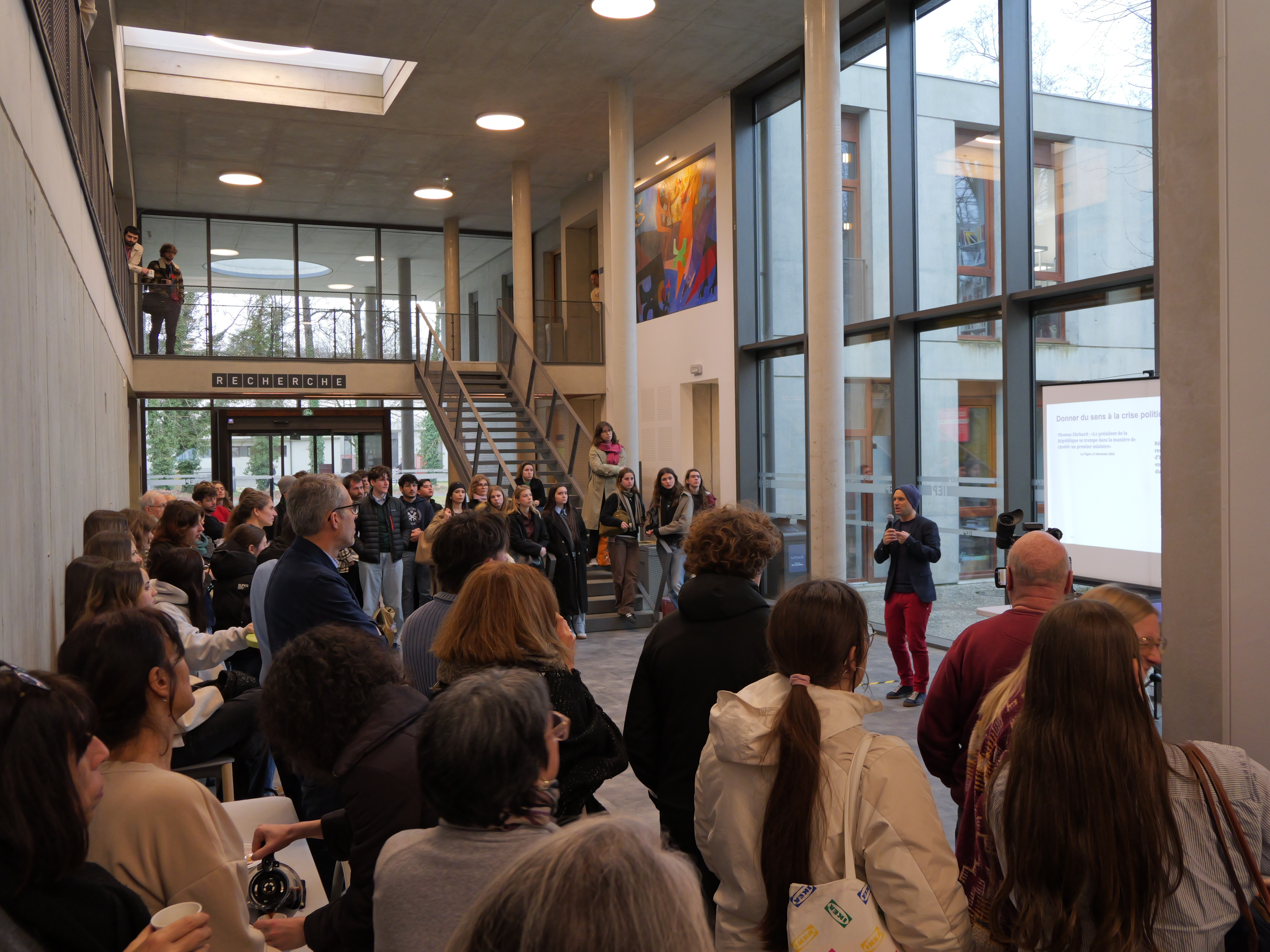
Understanding Electoral Shifts in France Since 2017
Research Forum No. 7: by Florent GOUGOU, Associate Professor of Political Science and member of the Pacte laboratory.
The Research Meetings provide a unique opportunity to learn about current projects, recent publications, and the latest scientific developments at the Faculty of Teaching and Research at Sciences Po Grenoble – UGA. Join us for a chat over coffee in a friendly and stimulating atmosphere on the last Tuesday of every month. Each session features two 15-minute presentations followed by an open discussion.