It is no longer just a question of informing people about the seriousness of the problem or the solutions to solve it, but of building collective awareness and stimulating the "
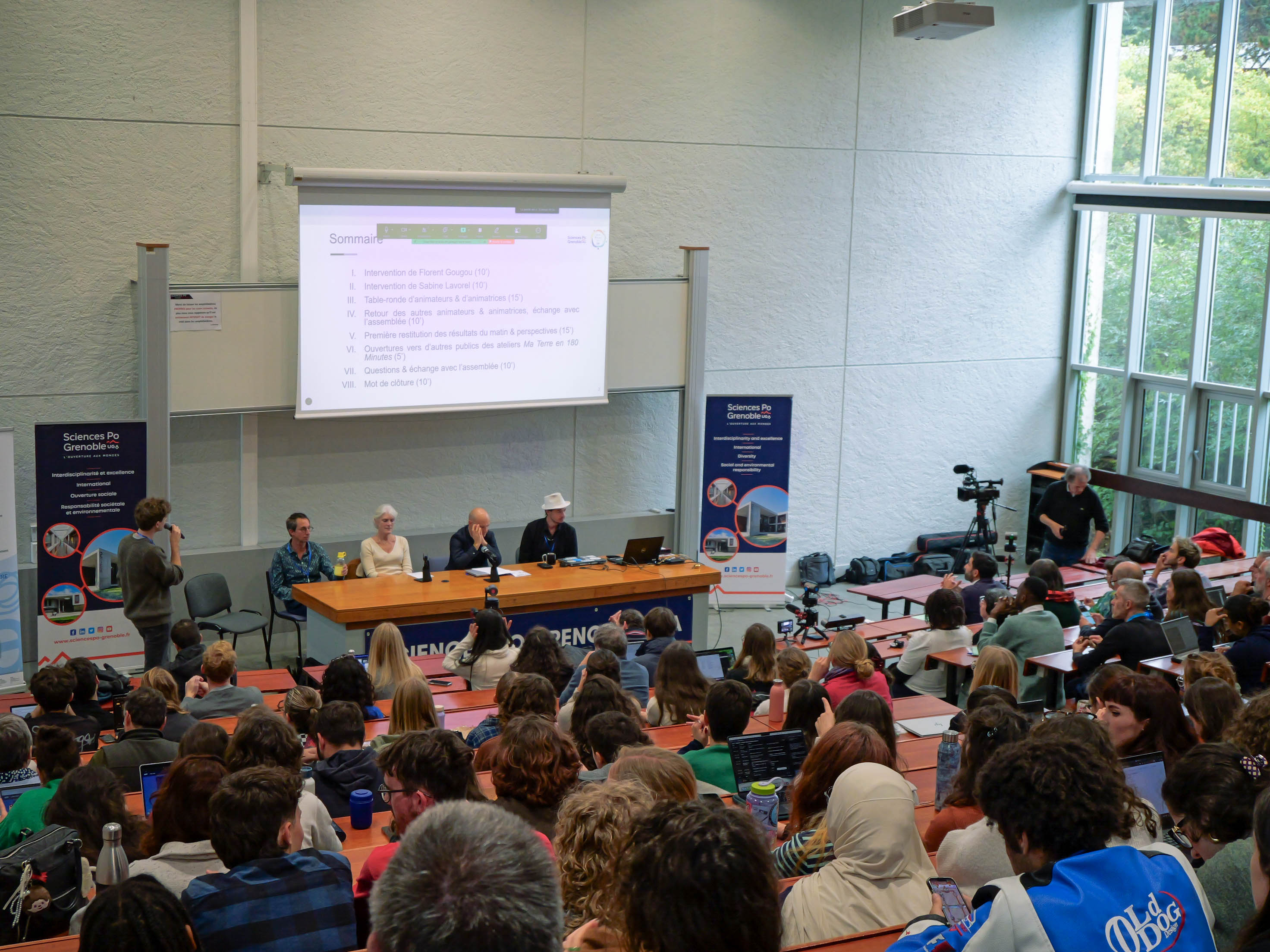
" of working together. To explore this avenue, Sciences Po Grenoble-UGA has experimented on a large scale with the use of the collaborative workshop Ma Terre en 180 minutes (My Earth in 180 Minutes) as a vehicle for active education and ecological transformation within the institution. The workshop promotes collective decision-making around concrete choices for socio-ecological transition and dynamically visualizes the effects of different scenarios. Adapting the program to the institution laid the foundation for a real decision-making process. The MaTerrathon brought together nearly 300 participants, including students, staff, and facilitators at Sciences Po Grenoble-UGA.
The MaTerrathon took the form of a participatory role-playing game, based on orders of magnitude and data from the institution's own carbon footprint assessment. Participants were divided into groups of 6 to 8 people, representing the diversity of individuals and roles. This allowed for deliberation on an equal footing, so as not to separate those who make decisions from those who experience the environments concerned on a daily basis. The aim was to identify concrete priorities for action and to understand the compromises necessary to reduce the institution's carbon footprint.
The objective was clear: to make a concrete contribution to the decarbonization of the institution, as part of the low-carbon project led by the University of Grenoble Alpes, with a stated target of reducing greenhouse gas emissions by 40% by 2030.
These deliberative workshops promote horizontal education, as well as awareness and Education the challenges of ecological transition. This highlights the importance of training students and pupils today in collective action and cooperation, based on scientific knowledge and institutional constraints. Active education experiences do not offer ready-made solutions to socio-ecological transition. Instead, they invite us to rethink the role of education, not as a simple lever for raising awareness or individual motivation, but as a space where shared diagnoses, discussed trade-offs, and collective decisions are made.
This news item is based on the article in The Conversation: "In the face of the climate crisis, can active education transform institutions?" by Michela Arciero, Nicolas Champollion, Nicolas Gratiot, and Simon Persico.
 45% of groups met or exceeded the 40% reduction target.
 Nearly half of the tables are in a range
35 to 45 percent discount.