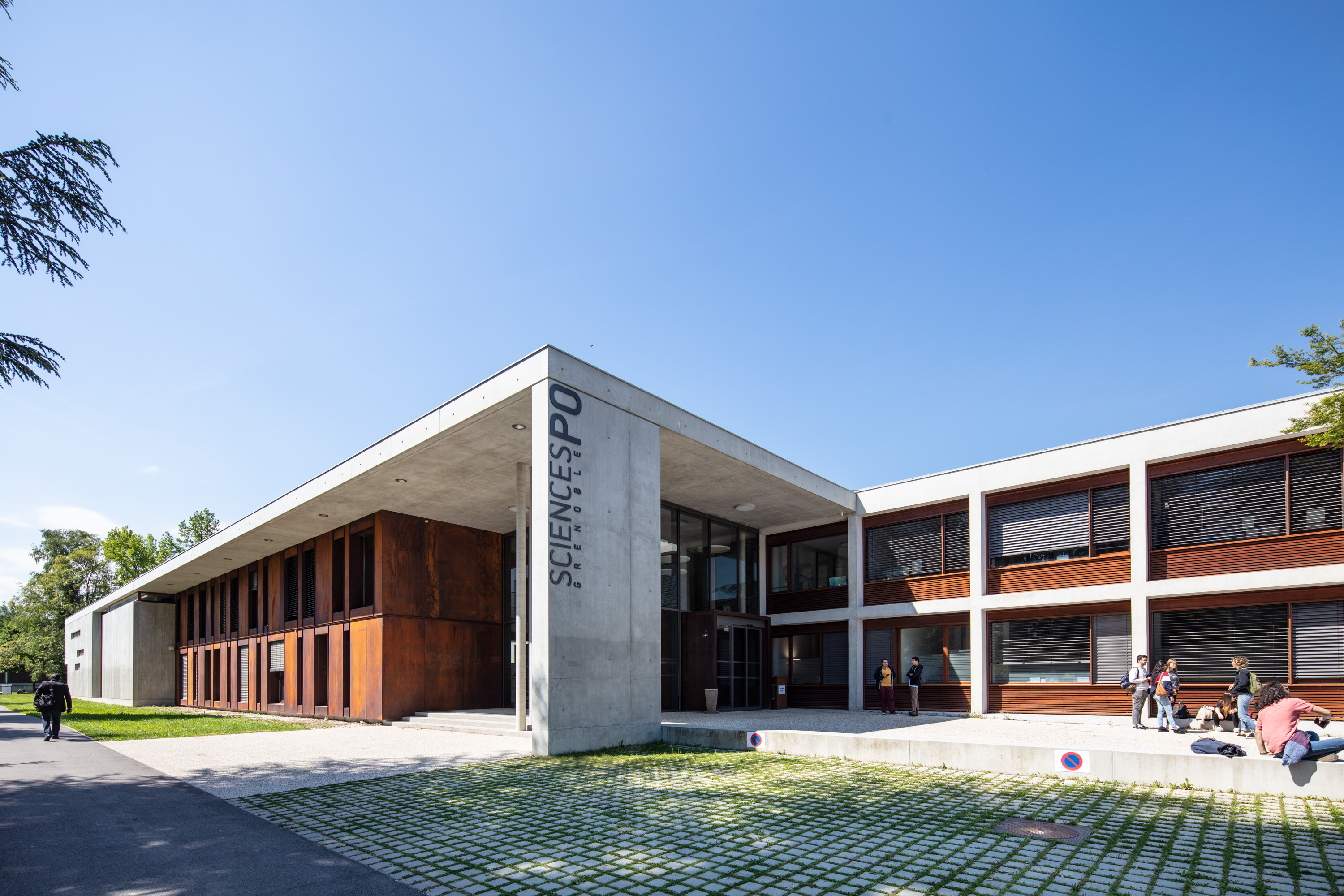
Why was the reform of the undergraduate program at Sciences Po Grenoble–UGA launched right at the start of the new administration’s term?
From the perspective of the curriculum offered to students—in other words, the knowledge and skills we impart to them—the educational reform aims to adapt our Education to the rapid changes in the world around us. Our students do indeed need new skills to successfully find their place in this world. This is particularly true in the areas of ecological and digital transitions, which will now be the subject of dedicated courses in the first and second years. This is also true in the area of research methods, as we have decided to raise our standards in quantitative data analysis by creating a new methods seminar in the second year. Finally, our students need a better understanding of how organizations function, which will be the focus of a new core management course, also offered in the second year.
But in reality, our educational model is not limited to the transmission of knowledge certified by a degree. In fact, we also support and guide our students through the many experiences we offer them during their studies, whether these are related to pedagogy—such as the relationships formed in a seminar or a Methods Conference—or extend beyond that framework, as seen in the Institute’s student organizations. In this respect, our educational model closely resembles that of British or American colleges: a small student body, close ties between students, faculty, and staff, and an educational vision in which knowledge about society is put to use in various forms of engagement with that society—and sometimes even in the pursuit of transforming it.
The reform of the first cycle aims to strengthen this educational model, which is currently under strain. Pressure from the labor market on academic institutions sometimes pushes us toward a mindset of excessive adaptation. The reduction in funding for public higher education in France—particularly in terms of human resources—also contributes to these tensions. Finally, the widespread use of generative AI in society poses a very significant risk to our educational model.
What are the most important measures in this reform?
The first involves postponing international study opportunities until the third year so that each student can build an ongoing relationship with their professors and classmates on campus before going abroad. To further enrich these two years, we give students more flexibility to tailor their curriculum to their interests and plans. Whether it involves choosing second-year Methodology Seminars, selecting specialized courses, or managing credit transfers and AJAC status (deferred but authorized to continue), all these measures are based on the same philosophy that places students at the center of life at our Institute.
We are also strengthening ties among students and encouraging their greater participation in the intellectual life of the institution. For example, we have ensured that French students and international exchange students now attend the same classes and collaborate more closely. We have also created a “project week” that allows faculty members and external partners to offer innovative activities to small groups of students at the end of the academic year. Finally, a new academic unit recognizes student engagement throughout the two-year program—whether through student organizations, civic involvement, or intellectual participation in debates and conferences organized by the university.
As for students’ ties to the faculty, we are also strengthening them by ensuring the seminar remains a core component and, over time, expanding the range of offerings to move toward small-group tutoring (10 to 12 students). We are also giving our instructors greater freedom to choose the format of their courses.
I’d like to add one final point: we wanted the reform to enhance our collective ability to reflect on our practices, discuss them, and evaluate them. That is why we created an Undergraduate Academic Council, where faculty members discuss our curricula and teaching methods, and why we hired two instructional designers to support us. We have also created a new course unit on “academic work methods” to help students quickly adapt to the often implicit workings of an academic institution. Finally, we are currently preparing the first edition of the future “ Education ” Report, which will provide an annual review of the successes and failures of our policy in this area.
Is this reform being implemented with the same level of funding?
No, on the contrary, we have decided to reinvest in our undergraduate programs. The diversification of our student body, as well as the emergence of generative AI, has convinced us that we need to provide better support for students starting in their undergraduate years. The reform therefore results in an equivalent number of class hours for students but a structural increase in the number of hours required under the new curriculum for the institution (on the order of 13% of the total number of hours). These additional courses will be taught by faculty members, members of the affiliated faculty (notably CNRS researchers), visiting professors, and colleagues from the University of Grenoble Alpes (UGA).
The reform will also result in a temporary need for additional resources over a two-year period due to the postponement of the study abroad program to the third year. All of these transitional costs are covered by substantial funding from the UGA’s IDEX Education .
What method was used to implement this reform?
We wanted the reform process to embody, as much as possible, the principles of collegiality and democracy, which we hold in high regard. We therefore created numerous forums in which the reform was discussed and offered everyone who wished to participate—including faculty, students, and administrative staff—the opportunity to do so. This took the form of online consultations, a major two-day seminar attended by faculty and staff members, working groups open to everyone, and debates within the governing bodies leading up to the final decision voted on by the Board of Trustees in June.
All of this took more than a year, and I am very proud to have been able to lead this reform alongside my two colleagues in charge of the “ Education ”—Hedwig Mesana, Vice President of the “ Education,” and Hélène Dessaux, who is now the Institute’s Director General of Services. I would also like to sincerely thank everyone who supported this effort.
Can we say that the reform of the first cycle is complete?
A reform of this magnitude obviously takes time. So we still have some work left to do. For example, we have a few courses to finalize with the Undergraduate Academic Council, particularly those that will begin in the fall of 2027 to coincide with the launch of the new second-year program. We also have a few topics to explore in greater depth, such as student course evaluations, which need to be redesigned and simplified to increase participation and make it easier to process and share the results with colleagues. Hedwig Mesana is coordinating this effort, in which we are serving as a pilot program for the entire UGA.
You also have a proposal for a new charter on artificial intelligence.
The most important issue we are tackling this fall is, in fact, the Institute’s policy regarding artificial intelligence. It seemed difficult to us to reform the undergraduate program without taking into account the widespread use of generative AI chatbots among students. This is what we did in a working group this spring and then, with the help of Lara Sepcke and Ovidiu Gacea, our two instructional designers, we drafted a proposal in July that goes beyond most of the policies currently in place at many universities today.
We have, in fact, based our analysis on a set of observations that help document the risks that generative AI poses to the “ Education ” model I mentioned earlier. AI does not merely pose a risk to the integrity of student work evaluations or to students’ cognitive development. It also undermines the quality of academic life as a whole, for example by leading to a reduction in face-to-face interactions, a weakening of social and emotional skills, isolation, and even increased inequalities among students.
In light of this threat, we have devised a response aimed at minimizing the use of generative AI in the educational relationships fostered at Sciences Po Grenoble - UGA. To achieve this, our draft charter defines not only the responsibilities of students but also those of faculty and the administration. Indeed, the entire institution must commit to the responsible use of AI if we are to prevent a situation where, one day, our students use AI to take tests designed by AI or have their futures determined by AI.
How do you plan to get this charter adopted?
Once again, we place our trust in collective intelligence and academic democracy. Starting on October 5, we will organize a broad consultation involving all our students, administrative staff, and faculty members, who will be able to approve each article of the charter or raise objections with supporting arguments. The goal is to foster debate over a period of about fifteen days and, if necessary, revisit the articles that generate the least consensus before they are presented to the CEVIE in November and the Board of Trustees in December.
If everything goes as we hope, this charter will be implemented starting with the January 2027 semester. It will help make Sciences Po Grenoble - UGA an innovative and responsible institution that fosters critical, free-thinking minds capable of adapting to the world of tomorrow rather than simply enduring it.