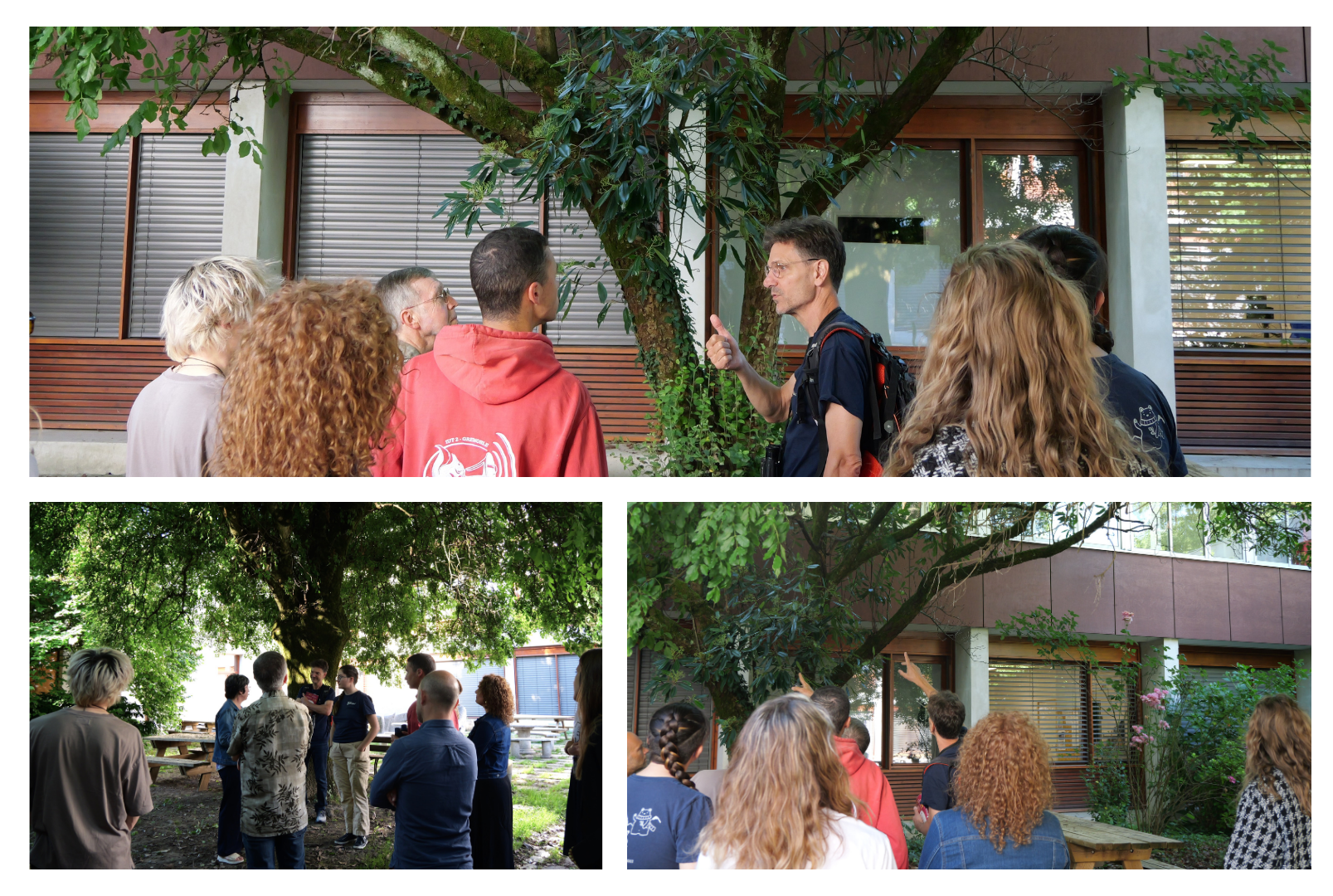
As part of Biodiversity Month, organized by the University of Grenoble Alpes this June, about twenty initiatives are being offered.
This is an opportunity at Sciences Po Grenoble - UGA to rediscover its courtyards in a new light, where the palmate maple—a veritable pantry for wildlife—casts its cooling shade, and the majestic Paulownia is home to a pair of wood pigeons. Other bird species nest nearby, such as the Eurasian magpie, which has built its nest just a few meters from the school’s entrance on the west side!
Every nook and cranny is used for nesting.
Between the roof and the wall, a small colony of house sparrows chirps above the windows of the administration offices on the east side, along with a pair of European starlings. The black redstart has made its home above the Amhi A building!
A few other species observed or heard during the visits: the robin, the blackcap, the citril finch, the blackbird, the kestrel, the carrion crow...
A pleasant and friendly way to start the day with colleagues and outside visitors.
Sciences Po Grenoble - UGA also aims to protect and promote these natural and architectural assets as part of its institutional development plan. To this end, a detailed landscaping proposal (covering needs analysis, plant species selection, management procedures, etc.) was developed by students in UGA’s Professional Bachelor’s Degree program in Landscape Architecture to launch future collaborative initiatives aimed at making these spaces more pleasant while preserving their natural character.
Grenoble Alpes University has been designated a "Biodiversity Refuge" by the LPO (League for the Protection of Birds and Biodiversity). Covering 200 hectares, it is the largest such refuge in the Isère department.