The Research Program DemoCIS, funded by France 2030 and operated by the ANR, organized a study day on June 26—one year after its launch—at the headquarters of the Hauts-de-France Region. This provided an opportunity for the interdisciplinary consortium of excellence—comprising four universities, three institutes of political studies, the CNRS, the Institut Mines Télécom, and Inria—to come together to address four major challenges:illuminating, protecting, including, and deliberating.
Researchers and practitioners exchanged views on the polarization of societies, information chaos, restrictions on civic space, experiences of citizenship, and the role of democratic innovations in the consolidation of democracy.
Frédéric Gonthier and Louise Bruyas (PACTE-CNRS) shared the initial findings of the Democracy Barometer – Everyday Perceptions, a national survey commissioned from the polling firm Cluster17 and conducted among more than 15,000 French citizens. The goal: to better understand how citizens experience, evaluate, and perceive democracy today.
Titled “How Precariousness Affects Democratic Preferences,” this study offers two key insights. The first is that the French people remain committed to the fundamental principles of the rule of law. In particular, the results highlight strong support for the oversight of governments by independent institutions, as well as for the protection of civil liberties and minority rights. There is also a clear preference for forms of governance that bring together elected officials, citizens, and experts, rather than a single model of political decision-making.
The second finding concerns the effects of precariousness. Contrary to popular belief, situations of economic and social vulnerability do not automatically lead to more authoritarian preferences. They are more closely associated with forms of democratic ambivalence: those in the most precarious situations develop more complex and sometimes contradictory expectations of institutions, without necessarily rejecting democracy.
Through the Democracy Barometer, Sciences Po Grenoble – UGA reaffirms its leading role in analyzing changes in citizenship and people’s relationship to politics. Future rounds of the survey will make it possible to track the evolution of these everyday conceptions of democracy through 2030 and to inform public debates on the future of French democracy.
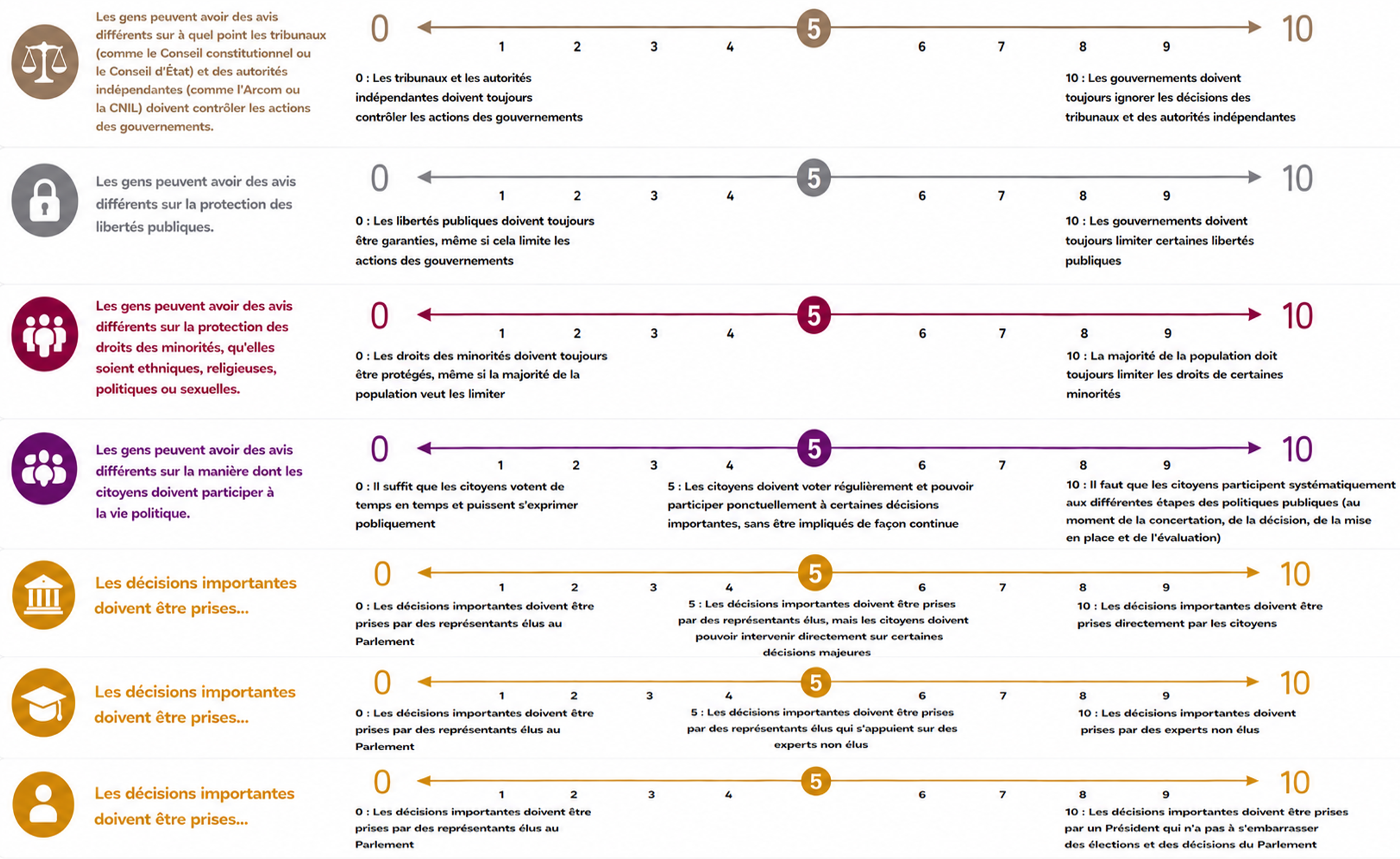
Interpretation - For each of the seven dimensions, survey respondents rate themselves on a continuous scale from 0 to 10, where 0 and 10 represent two opposing democratic preferences, and 5 represents a middle position.
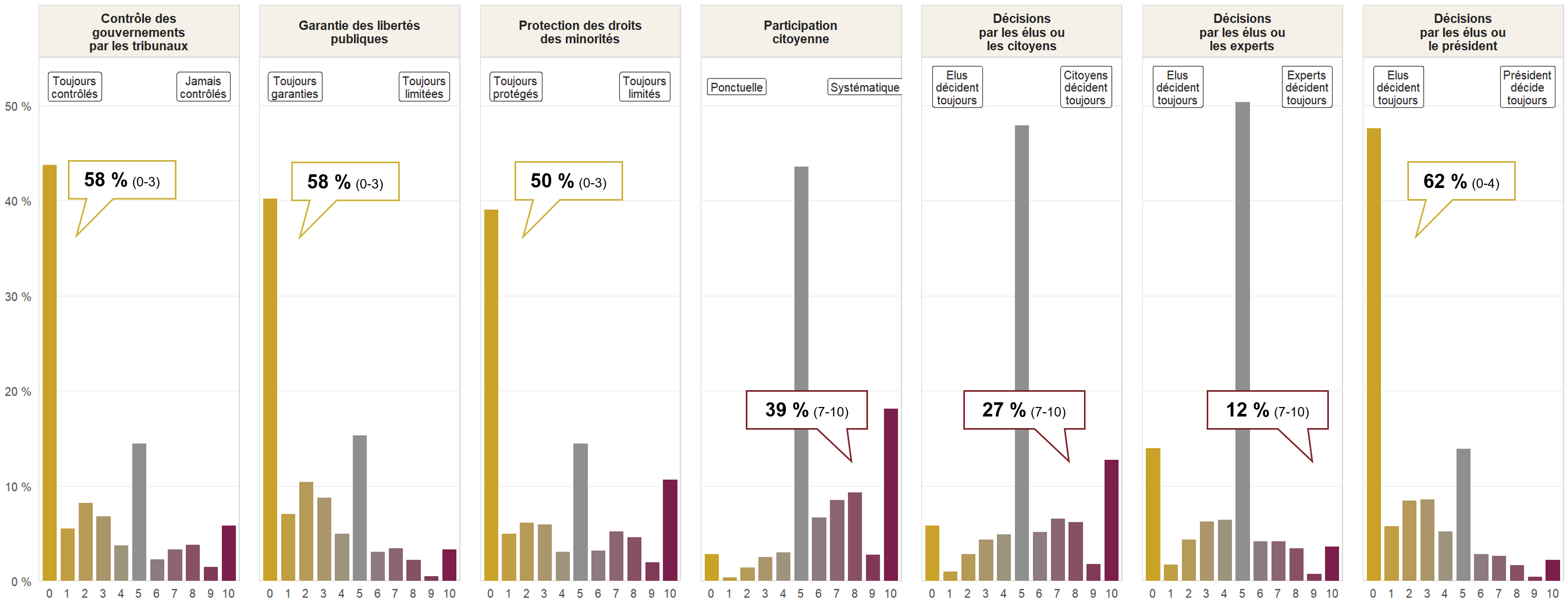
Survey: A majority of French men and women believe that governments should be held accountable, that civil liberties should be guaranteed, and that the rights of minorities should be protected. Fifty percent or more of respondents rate their views on these issues on a scale of 0 to 3.