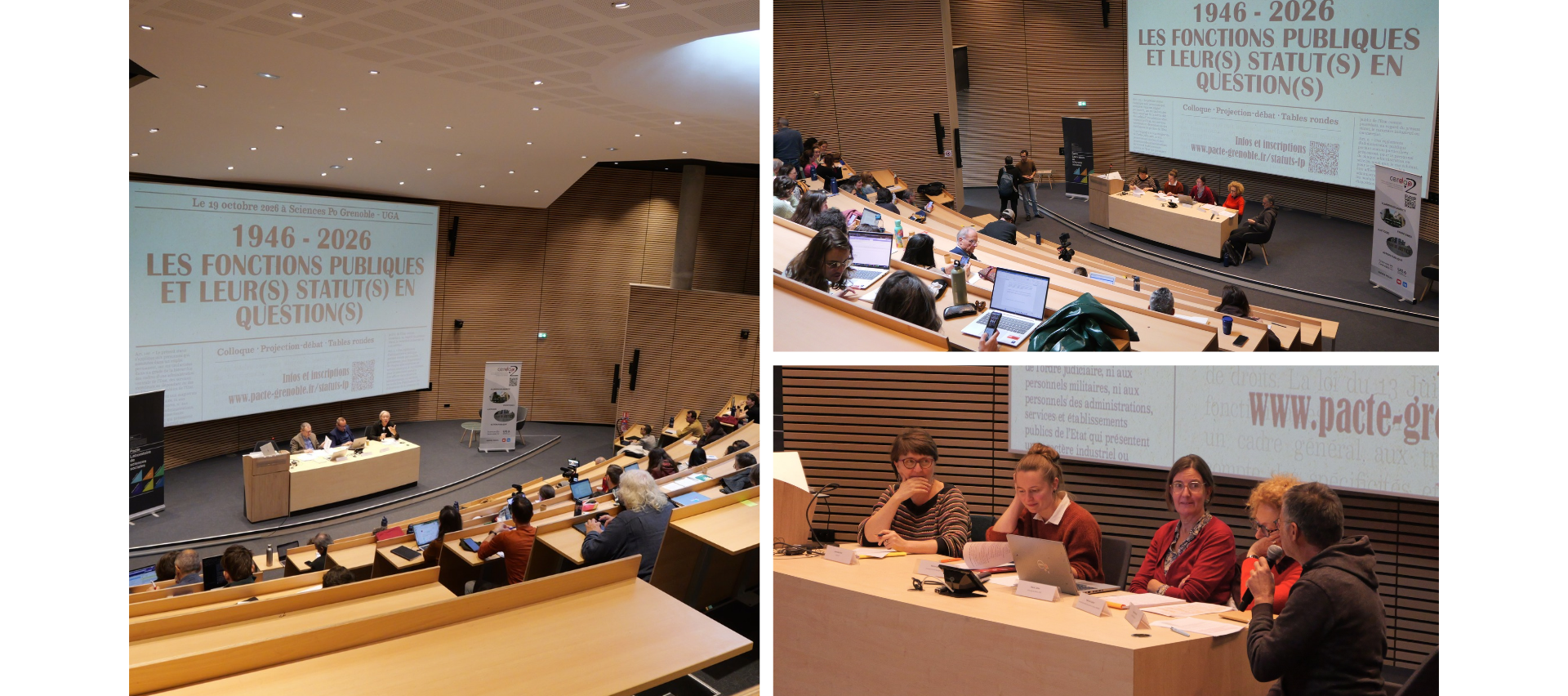
Since 1946, the status of the civil service has continually evolved in response to laws, reforms, and changes in the administration. These changes have gradually altered the status and employment conditions of civil servants, making them more precarious. While the status of a civil servant has long been associated with a form of “material security” and “symbolic resources,” “new public management” has gradually established itself as a new benchmark model. Beyond employment conditions, these developments are also transforming the actual working conditions within public administrations. The implementation of new public management tools is profoundly altering professional practices and the daily lives of public servants.
During this conference, four panel discussions served as the framework for discussions centered on four key issues. These panel discussions provided an opportunity to compare the perspectives of professionals and academics on changes in civil service status, which reflect the transformations taking place within the administration and the state.
Roundtable 1 - (De-)Embodying the Public Interest? Changes in Training and the Professional Identity of Public Servants
Willy Pelletier, sociologist and general coordinator of the Copernic Foundation
Fabrice Larat, Head of Research at INSP
Jean-Marie Pernot, former federal secretary of CFDT Finances in the late 1980s who went on to become a political scientist
Emmanuel Bellanger, Center for the Social History of Contemporary Worlds at the University of Paris 1
Roundtable 2 - Changes in Psychiatry: Is a Profession Disappearing?
Jean-Claude Bernard, a retired psychiatric nursing executive and former director of the “ Education ” program, continues his work at the CHS de la Savoie
Etienne Charenton, Nurse at GHU Paris Psychiatry & Neurosciences
Frédéric Mougeot, sociologist, research project manager in public health and social sciences
Roundtable 3 - Is the State’s “concern for itself” coming at the expense of its employees’ health?
Odile Join-Lambert, Assistant Professor at the University of Versailles Saint-Quentin-en-Yvelines
Anne Marchand, GISCOP 93: Asbestos Risk in the Public Sector
Marion Gaboriau, Lecturer and Researcher at the University of Clermont-Auvergne
François Marchive, Health, Safety, and Working Conditions Trainer, Institute of Social Studies
Roundtable 4 - Employment Status Under Pressure: Outsourcing, Contractualization, and Precarization.
François-Xavier Devetter, Lecturer and Researcher at the University of Lille
Julie Valentin, Lecturer and Researcher at the University of Paris 1
Marie-Julie Bernard, Lecturer and Researcher at Sciences Po Grenoble – UGA
Aurélie Peyrin, Lecturer and Researcher at UGA
Sophie Béroud, Lecturer and Researcher at the University of Lyon 2
Organization:
Renaud Bécot, Associate Professor of History and member of the Pacte research laboratory
Marie-Julie Bernard, Associate Professor of Public Law and Deputy Director of CERDAP²